Welcome ! This is a blog for people who want to be a friend of Wincobank Hill, for those who are fascinated, curious or concerned about the unique hill fort set high above Sheffield's Don Valley, encircled by ancient woodland that conceals the mysteries of history.

Who was here and why? Did they live, work or keep watch here? What part did this place play in the politics of an emerging nation? Was this the cradle of the British metal industry? And where was the water?

So many people are beginning to retell their stories, ask good questions and make suggestions that it's time to share what is happening ....

Wednesday, 17 July 2013

Penny reporting from Caerau Hillfort, Cardiff

There's something pretty special going on up a hill in Cardiff.  Not just any hill - but one just like ours.  And what's nice is that we were invited to join the party. The logistics of organising a coach trip to Wales defeated us and, as there really wasn't room in Cousin Betty's bungalow for all the Friends of Wincobank Hill, I went on my own with a mission to bring back the news of those long lost Celts who once lived on the hillfort in the district of West Cardiff now known as Caerau and Ely.

I just missed the weekend community dig and celebratory hog roast that had followed the first fortnight of excavation. I didn't stoop to pick up a trowel, neither did I shake the sieve,  But I talked to people and I listened.  And now I'm trying to remember what was said.  There was just so much that made me realise how similar the two projects are and just how much we can learn from each other.

Wincobank has its trials with speculative builders trying to plug the greenspace gaps between houses.
Fifteen years ago or so, Caerau was under threat from a new dual carriageway planned to run right through the middle of the hillfort.  A damage limitation compromise still resulted in the loss of a slice of woodland. You can just see the road cutting between the trees.
 The housing development couldn't get much closer either, Heritage Close is exactly what it says - close to the heritage - probably on top of it.   Just like the houses on Fort Hill Road are almost part of Wincobank Hillfort.

All the other challenges are there too - vandalism, litter, graffiti, off road vehicles.  The woodland paths are overgrown and steep. Barbed wire encloses the summit to contain the cattle who usually graze on the hillfort. The picturesque ruin of St Mary's Church is a focus for anti-social behaviour and local people, who remember it as an active church and lively youth club are trying to keep it tidy and protect the ancient graves.

It is the Friends of St Mary's who are the main community partners and several members were on site, working in the blazing sun to scrape away the dry and dusty soil searching for fragments of molten metal in the clay that might suggest early metal working. Not far away, a team of university students were gradually revealing the gulley and post holes of an enormous round house that was large enough to shelter three generations of a family along with their cattle. I was really impressed with the patience and persistence of the diggers and how willing they were to explain to visitors what they were doing and how important this experience was to them.

Every find was carefully logged on an individual sheet, bagged up and sent to the finds store at the local Glyn Derw High School where school pupils had the opportunity to help sort and wash the collection.  The school staff had welcomed the opportunity to be involved with this three year project and were delighted that their young people were able to benefit from working alongside the university students.  There was clearly a very good relationship between university and school based on an understanding of each other's needs and priorities. The school staff had found opportunities for meaningful history research, art, creative writing and technology and talked about individual children who had  been really inspired and affected by the project.

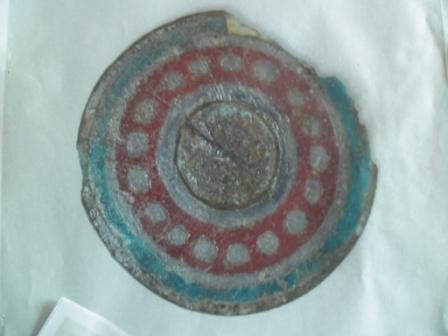
There was much talk about a beautiful brooch that had been found, but wherever I went it seemed to be somewhere else.  The closest I got to this finding it was this enlarged photograph pinned on the notice board in the school art room so I am still guessing that this it.  I was amazed that such a beautiful piece could survive and keep its colour for thousands of years.  Perhaps this brooch will appear in the history books of the future and I will be able to say I was near to its discovery and I think I nearly saw it. Hundreds of school children and community volunteers will certainly be able to tell their grandchildren that they saw it, held it and remember the excitement. A priceless memory.


Sunday, 12 May 2013

Making iron the Iron Age Way

In April 2013, as part of the Woolley Woods Bluebell Festival, local people were offered the chance to take part in a two-day Ancient Metallurgy course, learning how our early ancesters may have made iron.  Scroll down to see how plenty of mud, straw, iron ore, charcoal, muscle power to pump the giant bellows and a lot of patience produced results and smiles all round.


Saturday, 9 March 2013

University Challenge

.   Climbing Wincobank Hill was a misty and mysterious experience for 30 students from the University of Sheffield who were out on a visit as part of their Heritage,  Place and Community Module.
On arrival at nearby Upper Wincobank Chapel, they were given a brief introduction to the history of the area and an outline of the challenge of trying to engage all  local residents in preserving and protecting the heritage through activity that includes and benefits all sections of the community.  After a walk through the woods and around the perimeter of the hill fort the group returned to the chapel where they shared their ideas on how to make the most of the site and find a win-win solution to some of the major issues such as the traditional, albeit illegal use of the site for off road motor cycles.  There were some really thoughtful suggestions made and it is to be hoped that some of the students will opt to use Wincobank Hill as the subject of their case study and share their work with us.  A lovely group - please come again.

Wednesday, 27 February 2013

Litter ! what are we going to do ?

 What are we, as a nation, going to do about the growing problem of litter and dumping?  As council services are cut and the charge for disposal of rubbish increases how are we going to prevent our open spaces degenerating into rubbish dumps?

So many people complain about the council not clearing up the streets and alleyways that it may have been better if the council had never cleared it up in the first place because it has made us lazy.  We expect someone else to do the dirty work.
It is reasonable to say that we should not have to clear up after others - so therefore we need to work harder at stopping dumping in the first place.  Campaigning for less packaging, more biodegradable material and recycling of glass bottle would help.  The glass problem has got worse since the supermarkets started selling alcohol and refused to operate the deposit system that off-licences had run for years.  But they do on the continent.  A litter fine can be levied, but by whom?  The council do try to track people down but the bags of used nappies we picked up today had  no address.
 In Singapore there is a £1,000 fine for littering.  That would be worth collecting.  It is up to us to lobby for action to prevent our open spaces becoming a health hazard.  It is also up to us to get out there and pick it up.  Many people do, but we need more.

Wincobank Wombles will be out on Wincobank Hill every second Saturday in the month this year, tidying up, cutting back the new growth on the hill fort and having a laugh with friends.   Bring the family and come and help.  10 am - 12.30pm . Meet at Upper Wincobank Chapel.

Monday, 10 December 2012

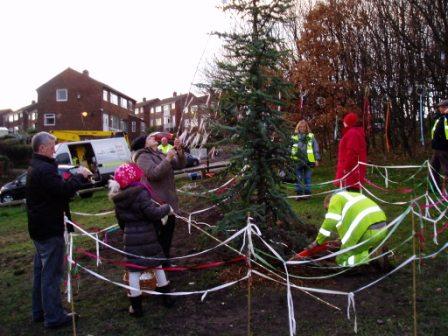
A Christmas Tree for the Common


It sounded such a simple idea - a Christmas Tree to light up that dark stretch of open space opposite Sandstone Road.  The vision of families gathered round the glittering tree singing in festive harmony was irresistible.  Community First funding was just a bid away, and the North East Community Assembly were encouraging, but securing the funding - as always - is just the start.

So - what do you need for a community Christmas Tree?  A tree, lights, and electricity.   And a lot of energy, faith and good humour to bring it all together.


 I was reliably told that the only person who could accomplish all this was our North East Community Assembly Manager, Alison Rayner.  I know now that this statement was true.  But poor Alison was up to her ears in pine needles and other more important work so I  thought I'd have a go.  I have learned a lot.  I have been out with the Woodlands Manager to look at beautiful trees in the nursery all waiting to find good homes and I have met the SWEEP team - Sheffield Woodlands Environment Enhancement Project who work with volunteers to make our woodlands even more beautiful.


I have learned that a hole can be just too big for a tree and seen how small and lonely a baby Cedar looks on the back of a lorry.

 I have seen how the SWEEP  team anchored the tree down so that hopefully, it won't blow over in the gales.  It is tightly wired in, using that magic Sheffield invention: The Gripple.   The cavity has been packed with yummy compost and the soil packed tightly back in.  A plastic conduit takes the cable from power source to the tree.  At least that's the plan.

I feel I have now met most of the Amey team who now look after our street lights.  I have discovered that there is more than one way to dig a trench, and several directions in which it can be dug.  I can see that sometimes things just don't go according to plan and I have perfected that deep intake of breath and shake of the head that can only be accomplished when wearing a high vis jacket.
 With a lot of goodwill and persistence, many phone calls resulting in the the miraculous appearance of a generator, we finally managed to connect the tree to electricity.

Friends brought home made decorations to dress the tree and soon it was sparkling with silver tinsel and gold foil.  The nearby trees which had already lost their leaves were festooned with ribbon and the tiny flickering battery candle lamps which had lit up the woodlands for the lantern pageant were hung in the bare branches to add to the magic.
As dusk fell to darkness, the families came out. Even Santa turned up with a big bag of chocolate.  From Jingle Bells to Silent Night, Away in the Manger to the the Twelve Days of Christmas we did our best to sing the Christmas season in.

There is a bit of remedial work to be done now and a few more phone calls to be made.  But now, when I see the Christmas lights across the city, I will think of all the people who have done their bit to make the lights shine and I will say a silent thank you to all, for brightening up the long dark winter nights.  Penny.

Thursday, 22 November 2012

Sunshine ahead

Spring will soon be here and our lovely common will be blessed with sunshine daffodils thanks to the work of the volunteers who have been working with the North East Action Team to brighten up the neighbourhood by planting bulbs.  In the grey days of this everlasting depression flowers are a simple pleasure and joy.  Thank you.

Monday, 19 November 2012

Wincobank Lanterns Light Up the Hill 2012


 Over 250 people came together from local schools and across the area for a memorable and magical walk back through time to the days of the Roman occupation of Britain. 

Carrying willow and tissue lanterns made in school, the children and their families  set out in a procession led by drummers to seek the rebel leader King Caratacus.  
 Passing between fluttering ribbons and twinkling candle lamps, the parade entered the mysterious darkness of the ancient wood safe in the company of City Council stewards.  

Out on the hillside at the end of the woodland path, the sparkling lights of Sheffield and the Don Valley lit up the night with a warm glow. 

Turning up the south-west slope of Wincobank Hill the walkers made their way up towards a lone piper playing by a glowing brazier. 

Drawing breath, people turned to look back at the path they had climbed and gasped to see the millions of glittering lights stretching far into the distance. 

One child was overheard to exclaim: “Oh look – it’s the world!”

This view from the hill is seldom seen at night and the memory will stay with us all for years to come.

 Following the trail of candle lamps the procession moved up the hill to find archaeology students from the University of Sheffield working metal on an anvil beside the roaring flames of a reconstructed iron age forge.

The atmospheric Celtic melodies from Foxy Music instrumentalists drifted through the air and by the time the line of lantern bearers had crossed the hill fort, the children were buzzing with excitement.
 Four huge flags fluttered against the night sky. Beneath them, illuminated by torchlight and the glow of braziers, members of the 53 Theatre Group captivated the crowd with a re-enactment of the betrayal of King Caratacus by Cartimandua, Queen of the Brigantes, who according to Tacitus, delivered him to the Romans in chains.   

But some say that Cartimandua deserves to be remembered as a wise and strategic leader, determined to protect her people from the Romans.
 The crowd were immediately involved in the dilemma faced by Cartimandua who had made a trade agreement with the invaders, securing peace. Caratacus was trying to raise a rebel army and so threatened the peace of the region. 


As Caratacus was led off in chains, the weary, happy, but hungry procession continued down the dark path between the oak trees and back to the warm and welcoming Upper Wincobank Chapel for hot chocolate and cake. 


Many thanks to Catherine Nuttgens and James Smith for helping to organise this amazing event which was funded by Communities First and Natural England


The event was supported by volunteers from by Friends of Wincobank Hill, Sheffield University Department of Archaeology, 53 Theatre Group, Sheffield and Rotherham Wildlife Trust, Upper Wincobank Chapel and Wincobank Youth Group.  Thanks also to Foxy Music, Anna-Mercedes Wear and Helena Reynolds for their great contribution.