Welcome ! This is a blog for people who want to be a friend of Wincobank Hill, for those who are fascinated, curious or concerned about the unique hill fort set high above Sheffield's Don Valley, encircled by ancient woodland that conceals the mysteries of history.

Who was here and why? Did they live, work or keep watch here? What part did this place play in the politics of an emerging nation? Was this the cradle of the British metal industry? And where was the water?

So many people are beginning to retell their stories, ask good questions and make suggestions that it's time to share what is happening ....

Friday, 31 January 2014


Five go to Rio Tinto: 12th - 18th January 2014

On Sunday 12th January Byron Cowling, David Green, Hilary Allen, Ken Allen and Roger Doonan travelled to Rio Tinto in Andalucia, Southern Spain to see for themselves the war memorial and the sites of the photographs in the album found by one of Byron's children about ten years ago. We wanted to know more about the people named on the memorial plaque and, most of all - “What was the connection with Wincobank and Sheffield? – How did the album arrive here?” We wanted to take “then and now” photos of the sites depicted in the album and find out as much as we could about the mine – especially during the time period of the album. Work stopped in the mine about ten years ago, but a local resident , a retired engineer, was hopeful that it might reopen sometime in the future.
We were successful in doing many exciting things and making good contacts but made only a beginning on our main objectives.
The monument is situated in the “English village”[Barrio Ingles], built for British employees at the beginning of the last century, called “Bella Vista”. This was an attempt  at a “little England” built in an English style, but with local materials,so that the mine officials and their families could live in the manner to which they were accustomed  separated from their other employees.
We were able to take” then and now” photos here though there are a great many trees now blocking what had obviously been a clear, or cleared, view with later buildings  encroaching on the monument space. Bella Vista is,surprisingly, adjacent to the deep workings of the mine. Our first view of the nearest crater was absolutely mind-blowing in its size,colours and depth – quite  shockingly beautiful . We found the English cemetery, now in disrepair, where the British employees were buried ,again separate from those of other nationalities.“Any  Sheffield names “wondered Dave.
We were unable to visit the Roman necropolis shown in the album  as it was fenced off and declared unsafe, but we took photos through the gate. In the town itself we visited the museum where the artefacts found on the site are on display, along with a replication of the underground mine workings and an actual railway engine with elegant wooden carriages furnished with fabulous leather seats that could be made into beds for the directors and important visitors to the mine. Byron and  Roger went into the museum archives to see if the answers to any of our questions could be found there but the files were so dense and references hard to follow so that with limited time they had little success. However the archivists  were  interested in our  search and will let us know if they find anything themselves. We had found a useful contact.
Whilst they were there the rest of us, whilst taking photos in Bella Vista, also made an interesting contact. Speaking almost no Spanish, Dave speaks a little, we met  by chance a journalist,who spoke no English but was very interested in the album . He took photos of us with the album and the next day arrived with civic dignitaries, [and an English speaking interpreter], to interview us. Thus we made it into the Rio Tinto newspaper and the internet!
We visited other areas of the mine and the lovely Moorish walled town of Niebla , the site of an archaeological dig shown in the album. The red river – rio Tinto – flows under a Roman bridge past this town. We had learned that the colour of the river is not due to working the mine but to natural leaching of the minerals. This colour is recorded in ancient documents.
The city of Huelva is located where the two rivers  Tinto  and Odiel join and flow together into the  Atlantic. Here we walked on part of the stunning double-storied pier that took two levels of train tracks carrying minerals from Rio Tinto mines to ships, and so across the world. Made from girders - from Scotland!
A final free day took us to Seville and ,on the way back to Huelva, to the home of an English geologist who had emailed Penny back in Wincobank. She emailed us. His private hobby was military history and he was therefore also interested in the story behind the war memorial. Hopefully another useful contact. 

We returned home with no answers, more questions, but a clearer picture of Rio Tinto itself and some useful threads in the story of the album.

To see the article in the Huelva News click here   There is an automated translation facility on the web page.
To hear a more from the intrepid travellers and to see their photos, come along to the meeting of Friends of Wincobank Hill from 6.30pm on Thursday 6th February at Upper Wincobank Chapel, Wincobank Avenue S5 6BB

Wednesday, 17 July 2013

Penny reporting from Caerau Hillfort, Cardiff

There's something pretty special going on up a hill in Cardiff.  Not just any hill - but one just like ours.  And what's nice is that we were invited to join the party. The logistics of organising a coach trip to Wales defeated us and, as there really wasn't room in Cousin Betty's bungalow for all the Friends of Wincobank Hill, I went on my own with a mission to bring back the news of those long lost Celts who once lived on the hillfort in the district of West Cardiff now known as Caerau and Ely.

I just missed the weekend community dig and celebratory hog roast that had followed the first fortnight of excavation. I didn't stoop to pick up a trowel, neither did I shake the sieve,  But I talked to people and I listened.  And now I'm trying to remember what was said.  There was just so much that made me realise how similar the two projects are and just how much we can learn from each other.

Wincobank has its trials with speculative builders trying to plug the greenspace gaps between houses.
Fifteen years ago or so, Caerau was under threat from a new dual carriageway planned to run right through the middle of the hillfort.  A damage limitation compromise still resulted in the loss of a slice of woodland. You can just see the road cutting between the trees.
 The housing development couldn't get much closer either, Heritage Close is exactly what it says - close to the heritage - probably on top of it.   Just like the houses on Fort Hill Road are almost part of Wincobank Hillfort.

All the other challenges are there too - vandalism, litter, graffiti, off road vehicles.  The woodland paths are overgrown and steep. Barbed wire encloses the summit to contain the cattle who usually graze on the hillfort. The picturesque ruin of St Mary's Church is a focus for anti-social behaviour and local people, who remember it as an active church and lively youth club are trying to keep it tidy and protect the ancient graves.

It is the Friends of St Mary's who are the main community partners and several members were on site, working in the blazing sun to scrape away the dry and dusty soil searching for fragments of molten metal in the clay that might suggest early metal working. Not far away, a team of university students were gradually revealing the gulley and post holes of an enormous round house that was large enough to shelter three generations of a family along with their cattle. I was really impressed with the patience and persistence of the diggers and how willing they were to explain to visitors what they were doing and how important this experience was to them.

Every find was carefully logged on an individual sheet, bagged up and sent to the finds store at the local Glyn Derw High School where school pupils had the opportunity to help sort and wash the collection.  The school staff had welcomed the opportunity to be involved with this three year project and were delighted that their young people were able to benefit from working alongside the university students.  There was clearly a very good relationship between university and school based on an understanding of each other's needs and priorities. The school staff had found opportunities for meaningful history research, art, creative writing and technology and talked about individual children who had  been really inspired and affected by the project.

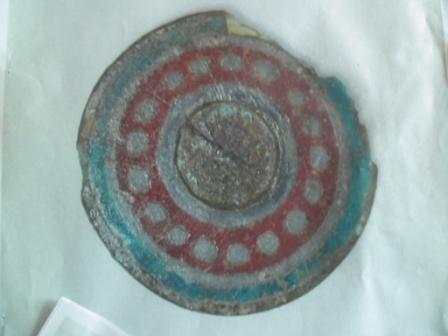
There was much talk about a beautiful brooch that had been found, but wherever I went it seemed to be somewhere else.  The closest I got to this finding it was this enlarged photograph pinned on the notice board in the school art room so I am still guessing that this it.  I was amazed that such a beautiful piece could survive and keep its colour for thousands of years.  Perhaps this brooch will appear in the history books of the future and I will be able to say I was near to its discovery and I think I nearly saw it. Hundreds of school children and community volunteers will certainly be able to tell their grandchildren that they saw it, held it and remember the excitement. A priceless memory.


Sunday, 12 May 2013

Making iron the Iron Age Way

In April 2013, as part of the Woolley Woods Bluebell Festival, local people were offered the chance to take part in a two-day Ancient Metallurgy course, learning how our early ancesters may have made iron.  Scroll down to see how plenty of mud, straw, iron ore, charcoal, muscle power to pump the giant bellows and a lot of patience produced results and smiles all round.


Saturday, 9 March 2013

University Challenge

.   Climbing Wincobank Hill was a misty and mysterious experience for 30 students from the University of Sheffield who were out on a visit as part of their Heritage,  Place and Community Module.
On arrival at nearby Upper Wincobank Chapel, they were given a brief introduction to the history of the area and an outline of the challenge of trying to engage all  local residents in preserving and protecting the heritage through activity that includes and benefits all sections of the community.  After a walk through the woods and around the perimeter of the hill fort the group returned to the chapel where they shared their ideas on how to make the most of the site and find a win-win solution to some of the major issues such as the traditional, albeit illegal use of the site for off road motor cycles.  There were some really thoughtful suggestions made and it is to be hoped that some of the students will opt to use Wincobank Hill as the subject of their case study and share their work with us.  A lovely group - please come again.

Wednesday, 27 February 2013

Litter ! what are we going to do ?

 What are we, as a nation, going to do about the growing problem of litter and dumping?  As council services are cut and the charge for disposal of rubbish increases how are we going to prevent our open spaces degenerating into rubbish dumps?

So many people complain about the council not clearing up the streets and alleyways that it may have been better if the council had never cleared it up in the first place because it has made us lazy.  We expect someone else to do the dirty work.
It is reasonable to say that we should not have to clear up after others - so therefore we need to work harder at stopping dumping in the first place.  Campaigning for less packaging, more biodegradable material and recycling of glass bottle would help.  The glass problem has got worse since the supermarkets started selling alcohol and refused to operate the deposit system that off-licences had run for years.  But they do on the continent.  A litter fine can be levied, but by whom?  The council do try to track people down but the bags of used nappies we picked up today had  no address.
 In Singapore there is a £1,000 fine for littering.  That would be worth collecting.  It is up to us to lobby for action to prevent our open spaces becoming a health hazard.  It is also up to us to get out there and pick it up.  Many people do, but we need more.

Wincobank Wombles will be out on Wincobank Hill every second Saturday in the month this year, tidying up, cutting back the new growth on the hill fort and having a laugh with friends.   Bring the family and come and help.  10 am - 12.30pm . Meet at Upper Wincobank Chapel.

Monday, 10 December 2012

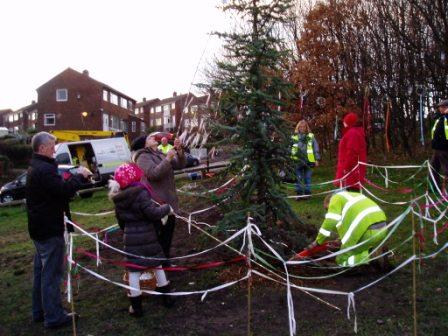
A Christmas Tree for the Common


It sounded such a simple idea - a Christmas Tree to light up that dark stretch of open space opposite Sandstone Road.  The vision of families gathered round the glittering tree singing in festive harmony was irresistible.  Community First funding was just a bid away, and the North East Community Assembly were encouraging, but securing the funding - as always - is just the start.

So - what do you need for a community Christmas Tree?  A tree, lights, and electricity.   And a lot of energy, faith and good humour to bring it all together.


 I was reliably told that the only person who could accomplish all this was our North East Community Assembly Manager, Alison Rayner.  I know now that this statement was true.  But poor Alison was up to her ears in pine needles and other more important work so I  thought I'd have a go.  I have learned a lot.  I have been out with the Woodlands Manager to look at beautiful trees in the nursery all waiting to find good homes and I have met the SWEEP team - Sheffield Woodlands Environment Enhancement Project who work with volunteers to make our woodlands even more beautiful.


I have learned that a hole can be just too big for a tree and seen how small and lonely a baby Cedar looks on the back of a lorry.

 I have seen how the SWEEP  team anchored the tree down so that hopefully, it won't blow over in the gales.  It is tightly wired in, using that magic Sheffield invention: The Gripple.   The cavity has been packed with yummy compost and the soil packed tightly back in.  A plastic conduit takes the cable from power source to the tree.  At least that's the plan.

I feel I have now met most of the Amey team who now look after our street lights.  I have discovered that there is more than one way to dig a trench, and several directions in which it can be dug.  I can see that sometimes things just don't go according to plan and I have perfected that deep intake of breath and shake of the head that can only be accomplished when wearing a high vis jacket.
 With a lot of goodwill and persistence, many phone calls resulting in the the miraculous appearance of a generator, we finally managed to connect the tree to electricity.

Friends brought home made decorations to dress the tree and soon it was sparkling with silver tinsel and gold foil.  The nearby trees which had already lost their leaves were festooned with ribbon and the tiny flickering battery candle lamps which had lit up the woodlands for the lantern pageant were hung in the bare branches to add to the magic.
As dusk fell to darkness, the families came out. Even Santa turned up with a big bag of chocolate.  From Jingle Bells to Silent Night, Away in the Manger to the the Twelve Days of Christmas we did our best to sing the Christmas season in.

There is a bit of remedial work to be done now and a few more phone calls to be made.  But now, when I see the Christmas lights across the city, I will think of all the people who have done their bit to make the lights shine and I will say a silent thank you to all, for brightening up the long dark winter nights.  Penny.

Thursday, 22 November 2012

Sunshine ahead

Spring will soon be here and our lovely common will be blessed with sunshine daffodils thanks to the work of the volunteers who have been working with the North East Action Team to brighten up the neighbourhood by planting bulbs.  In the grey days of this everlasting depression flowers are a simple pleasure and joy.  Thank you.